Drone Search and Rescue
Missing Person Search Support
Aerial thermal and visual search support over open ground, flown alongside the police and HM Coastguard, never in place of them.
If someone is missing right now and there is any risk to life, call 999 first. That is not a formality on this page, it is the actual first step, and everything below assumes it has already happened or is happening in parallel.
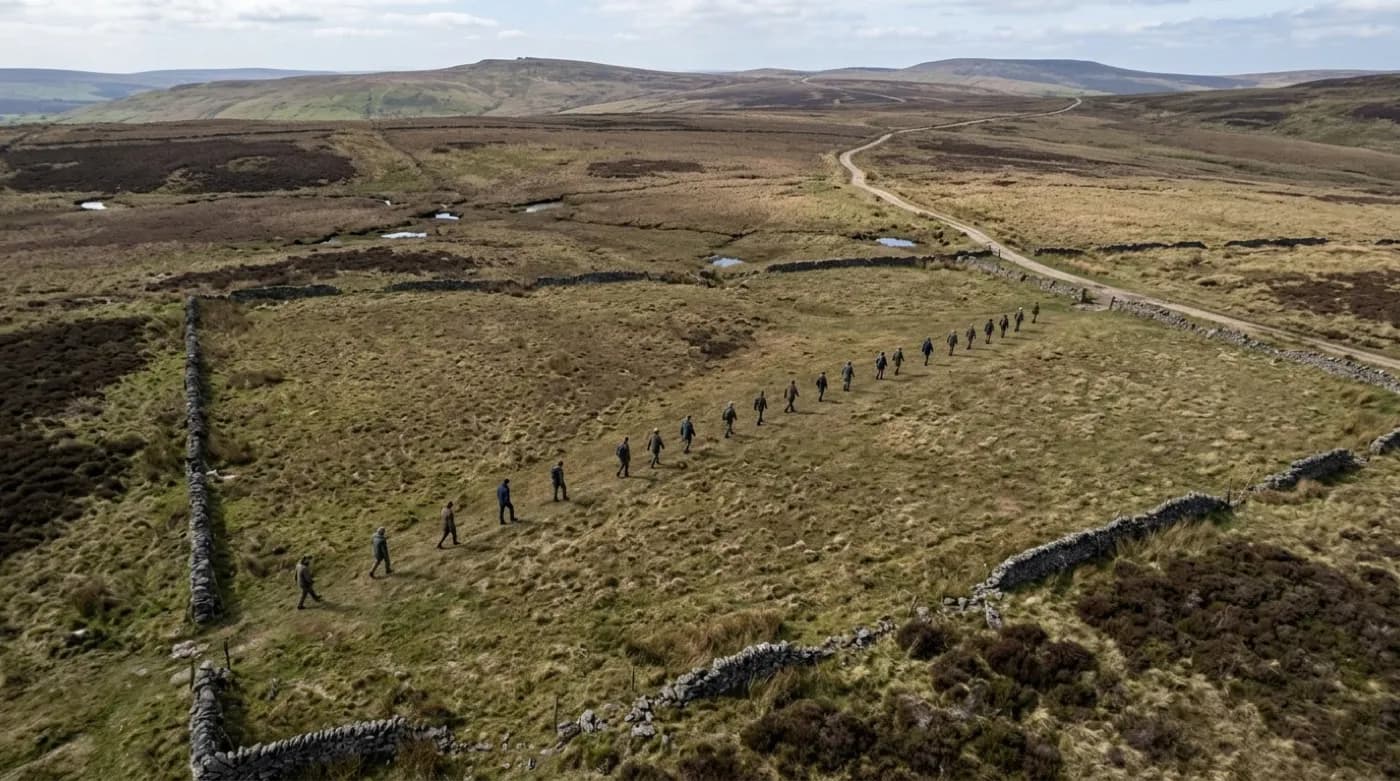
Once a search is under way on the ground, an aircraft can cover open moor, farmland, woodland edges and coast path far faster than people walking it, and the thermal camera picks up a warm body against cool ground or grass in conditions where the eye alone struggles, particularly at dawn, dusk and after dark.
This is support, not a replacement for trained search teams. Where the police or a search coordinator are already on scene, the aircraft flies under their direction and inside whatever restrictions they set for the area. Where nobody official is coordinating yet, and it is safe and lawful to fly, ground gets covered and anything found is reported straight away, by phone, not by email later.
What is included
- A fast visual and thermal pass over the agreed search area
- Real-time monitoring of both camera feeds while airborne
- An immediate phone call the moment anything is flagged, with a location
- Flying under police or search coordinator direction where one is present
- A plain note afterwards of what ground was covered and what could not be assessed
- Fixed price agreed on the phone before anyone sets off
What a thermal camera can and cannot do
A radiometric thermal camera reads temperature difference, not detail. A warm body shows up clearly against cool open ground, grass or bare rock, and it works in the dark, which is precisely when a ground search is hardest and slowest. That is the whole strength of it.
It does not see through dense tree canopy, through water, or reliably through thick cloud low enough to obscure the ground. On a hot day, when the ground itself has been warmed by the sun, the contrast between a body and its surroundings drops and thermal becomes far less useful until the ground cools again in the evening. None of this is hidden or softened when it is explained on the phone, because a false sense of what the camera can see is worse than no camera at all.
The visual camera still matters in daylight and covers ground the thermal camera is weakest on, including under partial cover and in bright conditions. Both cameras are flown together wherever the light allows it.
Working alongside a search, not running one
This is a private drone operator, not a search and rescue organisation, and nothing on this site should read otherwise. Where the police, mountain rescue, HM Coastguard or a lowland search team are already coordinating a search, the aircraft flies to serve their plan, inside whatever airspace restriction or cordon they have set, and reports directly to whoever is running that plan.
Where a family or a walking group is searching without official coordination yet, because it is early, because the person has only just been noticed missing, or because 999 has been called and a response is still on its way, an aerial pass over open ground while people wait can meaningfully speed up what happens next. It never replaces calling 999, and it never delays it.
The kind of ground this covers well
Open moorland, large fields, coast path and headland, riverbank and open woodland edge are where an aircraft earns its place fastest, because a person on foot covers a few hundred metres in the time an aircraft covers a whole hillside. Dense forest, deep gorse, and anywhere the ground is not visible from directly above are harder, and that limitation is stated plainly on the phone before anyone commits to anything, not discovered afterwards.
Coastal ground brings its own read: cliff edges, coves only reachable by boat or a long walk, and tide-exposed sand are all places where minutes matter and access on foot is properly slow. An aircraft crosses that ground in the time it takes to walk to the cliff top.
On the day
How Missing Person Search Support is flown
- Step 1
The call
Straight to the point: where, who is missing, how long, what has already been searched, and whether the police or a search coordinator are involved. If 999 has not already been called and there is any risk to life, that happens first.
- Step 2
Airspace and access check
A quick check for any restriction already in force over the area, including a police or coastguard operation, before a take-off point is agreed. This takes minutes, not hours.
- Step 3
The flight
A methodical pass over the agreed ground, visual first, thermal alongside or immediately after depending on the light. Anything worth a closer look gets a second pass straight away rather than being logged for later.
- Step 4
Report and stand-down
Anything found is called in immediately with a location, not written up afterwards. Once the search is stood down, or the aircraft has covered what it can, a short note of ground covered is provided for whoever is coordinating.
Behind the work
Kit, cover and qualifications
CAA registered
Operator ID and Flyer ID held, plus the A2 Certificate of Competency. Paperwork is available on the phone before a flight, including to the police or a search coordinator if it is needed.
Radiometric thermal
A DJI Mavic 2 Enterprise Advanced carrying a 640 by 512 thermal camera, strongest at dawn, dusk and after dark, which is when a ground search slows down the most.
100 megapixel visual camera
A DJI Mavic 4 Pro with a Hasselblad camera and 6K video, used for daylight coverage and for legible imagery of anything found, close enough to act on.
Insured with Coverdrone
Full commercial cover for the operation. Certificates go to a search coordinator, a landowner or an event organiser as a matter of course, without anyone having to chase for them.
Missing person support
Missing Person Search Support questions
- Should I call you or call 999 first?
- 999 first, always, if there is any risk to life or someone is missing in circumstances that could be dangerous. This service supports a search that is already under way or about to be, it is never the first call to make.
- Will you take over the search?
- No. Where the police or a search coordinator are on scene, the aircraft flies under their direction. Where nobody official is coordinating yet, ground gets covered and reported back to whoever is searching, which is support rather than a takeover.
- Does the thermal camera work at night?
- Yes, and that is where it is strongest, because a warm body against cool night ground reads clearly and a ground search after dark is at its slowest and most dangerous. Deep tree cover and water are still blind spots regardless of the hour.
- How fast can the aircraft actually be airborne?
- Once the address or grid reference and a safe, lawful take-off point are agreed, the aircraft can usually be in the air within the hour. The exact time depends on distance from Exeter and on whether airspace needs checking against an existing police or coastguard operation.
Where
Missing Person Search Support across the South West
Also on this site
See how a search is flown
Call now, same day with Drone Search and Rescue
Call with the location and what has happened. Sam Hembury will come back with a fixed price and get airborne as soon as it is safe to.