Drone Search and Rescue
Missing Livestock Search
A fast aerial search for stock missing on the moor, across a large holding, or through a broken fence line, thermal capable and priced fixed before anyone sets off.
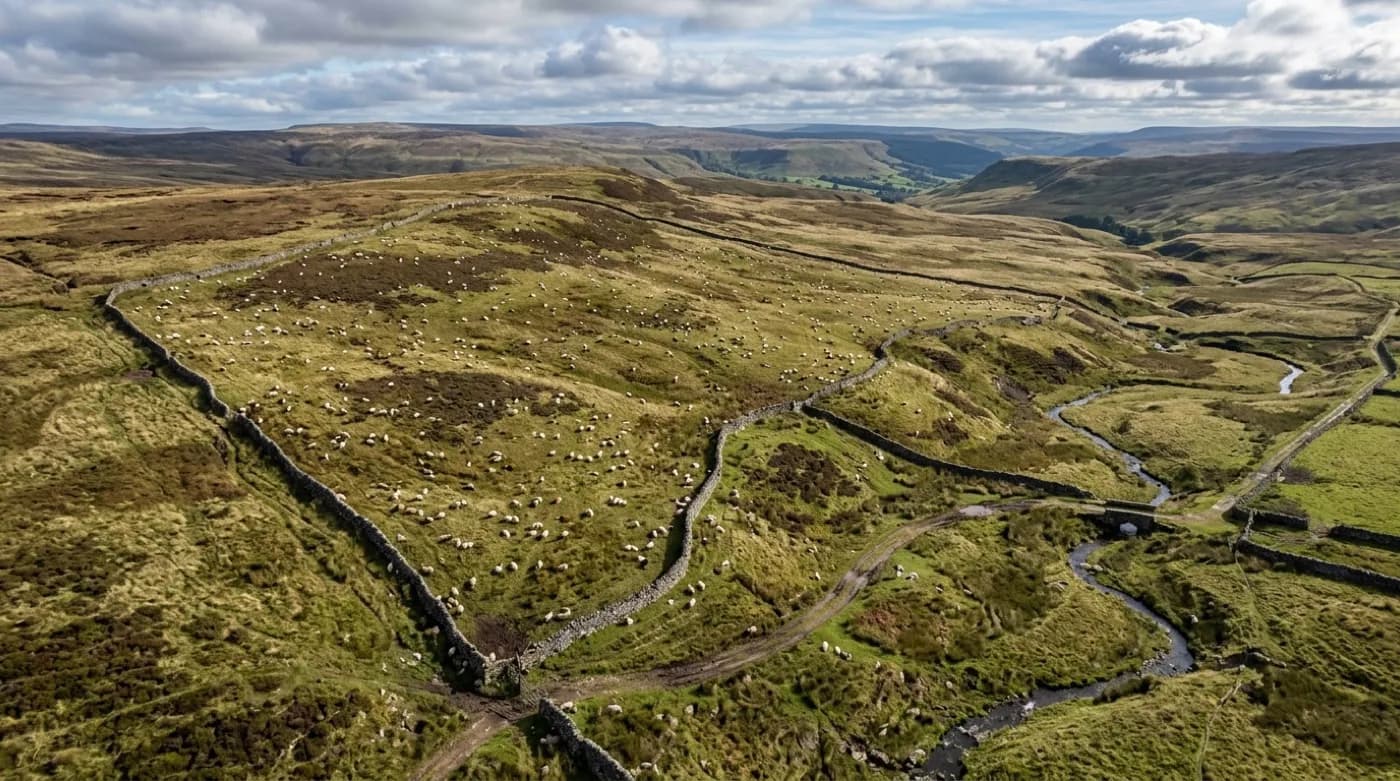
Stock gets out. A gate is left open, a fence goes down in weather, a ewe goes through a hedge after a lamb, and what should be an afternoon job turns into hours of walking ground that a person can barely see across, let alone search properly.
An aircraft covers that same ground in minutes. Sheep, cattle and horses all show up clearly against open moor or a stubble field from height, in daylight, and a thermal pass at dawn or dusk finds a warm animal against cool ground even where the visual camera would miss it in poor light or thick cover.
This is priced and flown the same way regardless of what has gone missing: a fixed price agreed on the phone once the ground and rough area are known, and the aircraft in the air the same day wherever weather and daylight allow it.
What is included
- A systematic aerial pass over the holding, moor allotment or search area
- Thermal pass at dawn, dusk or after dark where daylight has run out
- A phone call the moment stock is spotted, with a location or a direction to walk in
- Coverage of adjoining land and boundary lines where stock is likely to have moved through
- A fixed price agreed before the flight, no surprise on the day
- No scaffolding, no quad bike needed, no walking the ground that has already been searched twice
Why open ground is where this earns its keep
A person walking a moor allotment or a run of large fields covers a fraction of it in an hour, and stock that has gone through a gap tends to keep moving rather than stand and wait to be found. An aircraft flying a search pattern over the same ground covers it once, properly, in the time it takes to drive there.
Dartmoor and Exmoor commons, and the big hedged fields of the Somerset and Devon interior, are exactly the ground this is built for: large, often without a clear sightline from any one vantage point, and slow to search on foot or from a quad bike.
What thermal changes on a livestock search
Sheep in particular can be properly hard to see against pale grass or bracken from a distance, and stock that has bedded down in cover can be missed entirely by eye. A thermal camera reads the animal's own body heat against the cooler ground around it, which works even where the visual camera would struggle, and it keeps working once the light has gone, which a person on foot cannot say.
It is not infallible. Thick woodland canopy, deep bracken and standing water all reduce what thermal can show, and on a warm day the ground itself holds heat long enough to reduce the contrast. Where any of that applies to the ground being searched, it is said plainly before the flight rather than left as a surprise afterwards.
A same-day answer, not a day booked in advance
Livestock searches are rarely convenient to plan around. The aim is to be airborne the same day the call comes in, weather and light permitting, because stock that has been missing for a day is harder to find than stock missing for an hour, and every hour matters more as the light drops.
Where the weather will not actually allow a safe flight, that is said plainly rather than flown anyway for the sake of it, and the next safe window is given straight away.
On the day
How Missing Livestock Search is flown
- Step 1
The call
What has gone missing, roughly when, the size and shape of the ground involved, and any boundary or hazard worth knowing before take-off, such as livestock already grazing that should not be disturbed.
- Step 2
Ground and access check
A quick look at the area for any airspace restriction and for a lawful place to launch from, agreed with whoever owns or manages the land if that is not already the person who called.
- Step 3
The flight
A methodical sweep of the search area, boundary to boundary, at a height that keeps the ground legible without disturbing stock still where they should be. Thermal runs alongside the visual pass once the light starts to fall.
- Step 4
The call back
Found stock gets called in straight away with a location. If nothing is found on the first pass, the ground covered is reported plainly so a decision can be made on whether to widen the search or wait for better light.
Behind the work
Kit, cover and qualifications
CAA registered
Operator ID and Flyer ID held, plus the A2 Certificate of Competency. Paperwork is available on the phone before a flight, including to the police or a search coordinator if it is needed.
Radiometric thermal
A DJI Mavic 2 Enterprise Advanced carrying a 640 by 512 thermal camera, strongest at dawn, dusk and after dark, which is when a ground search slows down the most.
100 megapixel visual camera
A DJI Mavic 4 Pro with a Hasselblad camera and 6K video, used for daylight coverage and for legible imagery of anything found, close enough to act on.
Insured with Coverdrone
Full commercial cover for the operation. Certificates go to a search coordinator, a landowner or an event organiser as a matter of course, without anyone having to chase for them.
Missing livestock
Missing Livestock Search questions
- What kind of stock can you actually search for?
- Sheep, cattle and horses all show up well from the air, both on the visual camera in daylight and on thermal in poor light or after dark. Smaller stock such as pigs or goats can be harder to pick out at height depending on cover, and that is discussed plainly on the phone before booking.
- Do you need the landowner's permission to fly?
- Yes, for the land being flown over and for the take-off point. Where the caller is not the landowner, such as a livery client searching a neighbour's ground, that permission is sorted before the flight, not assumed.
- How big an area can one flight cover?
- That depends on the ground and the light, and gets discussed properly on the call rather than promised as a fixed number. A large moor allotment or several linked fields are well within a single visit, often in well under an hour of flying time.
- What if you don't find anything?
- You get a plain answer on exactly what ground was covered and what was not, so the search can carry on somewhere else with real information rather than a guess. That is worth having even when the flight does not turn anything up on the day.
Where
Missing Livestock Search across the South West
Also on this site
See how a search is flown
Call now, same day with Drone Search and Rescue
Call with the location and what has happened. Sam Hembury will come back with a fixed price and get airborne as soon as it is safe to.